
Fr. Brian Murphy • July 4, 2025
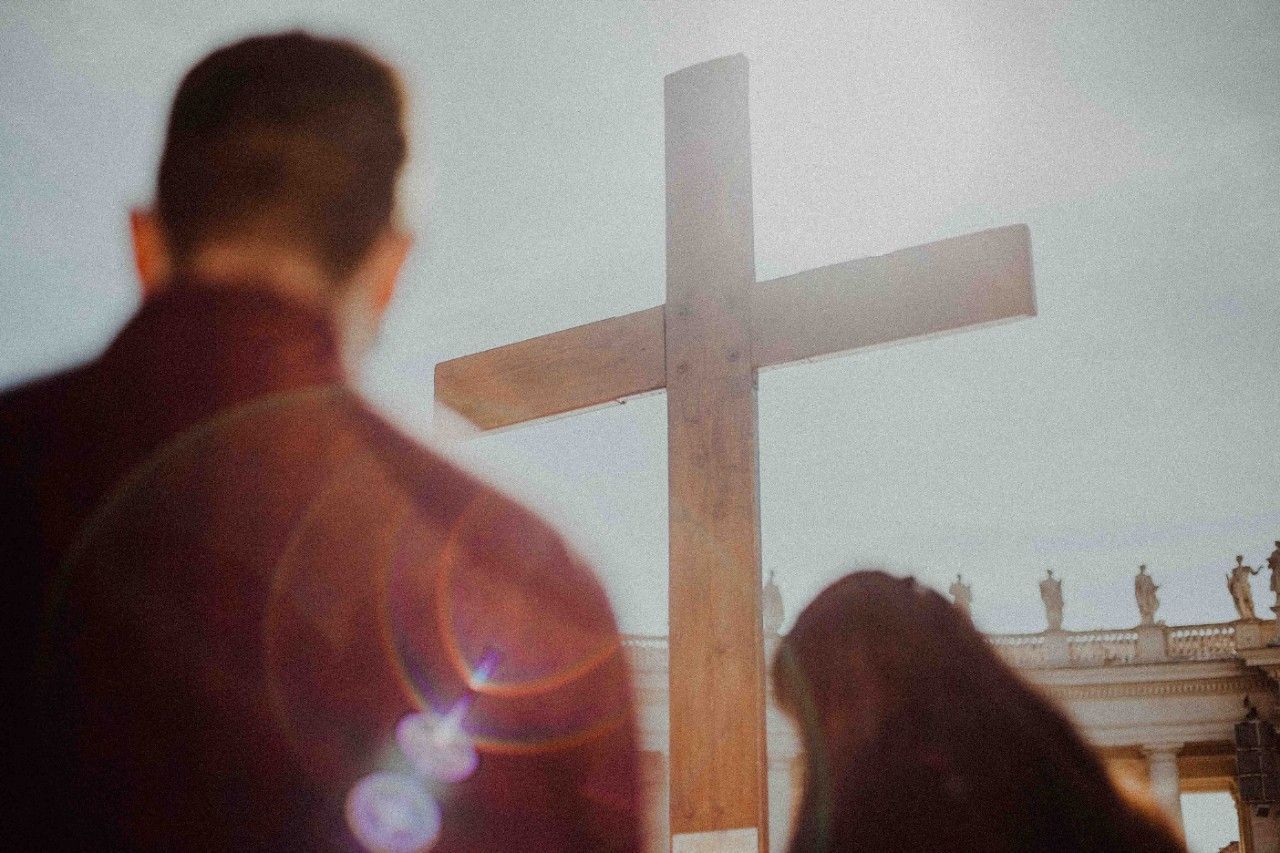
God gradually develops his salvation in stages. Let's take a moment to consider how he does this.
His people
On Easter night, the risen Jesus entered the upper room to the amazement of his people, and he eagerly breathed the Holy Spirit upon them. That moment was the culmination of 2000 years of God’s preparation for the renewal of creation. He had centred this preparation stage on his chosen people, Israel.
Long ago, God took a tribe of slaves out of oppression in Egypt. Then he led them through the desert for 40 years in which these wild spirits gradually made a covenant with him, because they saw his mighty deeds. It was his “right hand” alone that brought them victories.
Remember how Joshua and Hur held up Moses’ arms in prayer to bring them victory over the Amalekites? (Exodus 17: 8-12) The walls of Jericho tumbled down as they processed around them just praising God. (Joshua 6: 1-20) He led them to conquer city after city, becoming skilful warriors. Truly, as Psalm 44 says, it was by God’s “right hand and arm” that they gained victories, and it was “because he loved them”. That was an amazing time.
Then they settled and cultivated the land, became farmers and gradually their civilization developed; they started recording their history in books. But it was also a long period of centuries in which he stopped feeding them like babies – they had to grow up. They struggled to abandon their own tendency to invent their own gods, and slowly learned to deal with the real God in the way he demanded. All their worst vices came out and they had terrible times of crisis, but after two thousand years, they were at the stage where there were sufficient of them ready to receive the Messiah.
After Jesus had ascended to Heaven, God’s chosen people assumed their new name “Christians”. It was time to bring all people into Israel, the people who deal with God. He stunned them with spiritual victories as they converted the Roman Empire and assimilated the wisdom of many cultures especially the Greeks.
As they continued their journey of converting new peoples throughout the world, holiness flourished alongside depravity, all the worst vices came out and they struggled each in their day with evils within themselves.
A great Christian culture developed. Its fruits were: human rights, university learning, science and democracy, universal education, the founding of hospitals, to name a few. But that too was a preparation stage from which the next development is to take place. God’s renewal of creation is progressive not static.
What is the next development in God’s plan? In a prophetic poem, Christopher Fry writes:
Thank God our time is now when wrong
Comes up to face us everywhere,
Never to leave us till we take
The longest stride of soul men ever took.
Affairs are now soul size.
The enterprise is exploration into God.
Where are you making for? It takes
So many thousand years to wake… (The Sleep of Prisoners)
Our own day and age.
God has begun a great step forward in humanity, starting in the cradle of Christianity, the West. In order to prepare this next stage he has shaken his Church profoundly. He has exposed ways that were defective, with the result that many whose Christianity was mostly cultural and largely based on custom have slipped away. All this feels like things have deteriorated, but in fact he is renewing us from within. He is calling us to become more spiritual, more authentically Christian.
It may appear to some that, in calling us to be more spiritual, God is asking us to downplay the material world, but Christianity is immensely material - God became flesh, and was nailed with iron nails to a cross of wood - wood that had been his primary material as a carpenter. He is in the process of renewing the whole of creation through human collaboration. The spiritual is pressing down on the world so that we and it can be filled with God.
Faith seeks understanding
God's being is far beyond our capacity to understand him. We are to relate to him through faith and love. But Christian faith always thirsts to understand both God and of the world he has created for us to develop and care for. Over the centuries, God has inspired Christians to discover the laws he has set into his material creation, which has caused the flowering of thought and science in the West.
In recent years, much of this flowering of knowledge has become separated from its Christian roots, and we are faced with enormous potential for improvement which is deeply frustrated because, in isolating ourselves from the love of God, we have sealed the fountain of grace which enables us to properly love each other. Enormous love, which only flows from God's love is required to enable us to collaborate effectively in bringing creation to its glorious liberation . This can only be remedied by human beings maturing spiritually. God is busily leading us into that remedy.
He is causing the whole world to be shaken. Our knowledge of each other and the world has increased, leading us into a challenging time of flux. Cultures are mixing and also clashing. We are enthralled by the differences, and yet frightened of losing our identities nationally and as groupings in society. God has led us to this time in order to call us more deeply into our most profound identity - children of his created in his own image and likeness, called to bring the earth to flourishing.
Theories of everything
There are many false "theories of everything" which offer world-views of how humanity is to advance. Only Christ is the answer. Only Christ suffices.
The vision of the future offered by the so-called "progressive" philosophy has shown itself as brutalising, bogged down in overconsumption and endless "self-fulfilment"; it is hopelessly inadequate and visionless.
The next great remedy offered for the world's ills, Islam, is adhered to by many wonderful and loving people who loath the violence, misogyny and fanaticism advocated by other Muslims. They are similar to Christians who, not so long ago, were moving away from violence inflicted in the name of Christ. We have to pray that the peaceful vision of so many of these good people wins the day. Yet fundamental to their belief is the principle that the Koran must be literally interpreted with no provision for rational analysis. It produces a type of faith which impedes understanding rather than seeking it.
Christianity, despite the bogus claims that rational people left it behind at the time of the "Enlightenment", has, since the early middle ages, strenuously struggled to clarify and develop the relationship between faith and reason. This has led to the massive expansion of thought and science in recent times. This process has taken many centuries of debate, and the marriage of faith and reason is stronger today than ever. The process has been especially described in Newman's teaching on the development of doctrine where the basic revelation does not change, but its implications are continually being explored.
One can only conclude that both the "progressive" and the Muslim world views are constructs of brilliant but typically defective human thinking. The other dominant system, authoritarian dictatorship, seldom claims to be anything but human. In places like Russia today, it may borrow religious trappings, but, in demeaning people, and choking them it demonstrates its real failure.
Only the Spirit of Jesus moving in the Church proclaims that God has entered our world so that humanity can be incorporated into God. As the new stage in humanity's progress is being tumultuously born. God has been preparing his Church.
The process of Christian renewal in the West is God’s way of recalling us to rely more deeply on "his right arm" and his "love". Human development was reaching soul size. He is calling us into the exploration into God. Only as that progresses, will the world find the true secret of progress which is not primarily in the discoveries of science, but in the maturing of the human heart in Christ.